
Paper Revolutionaries
Dinaw Mengestu In The House

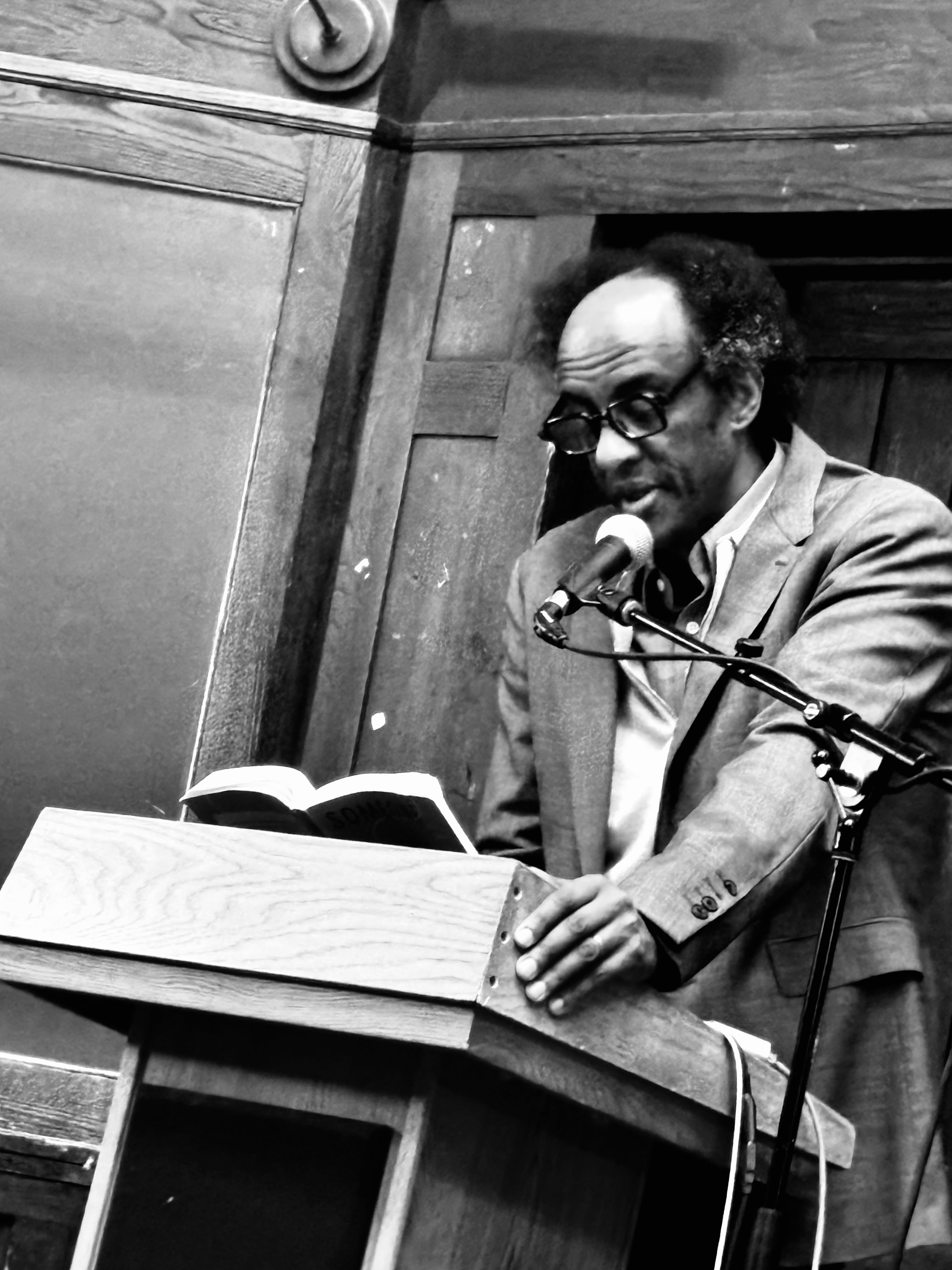
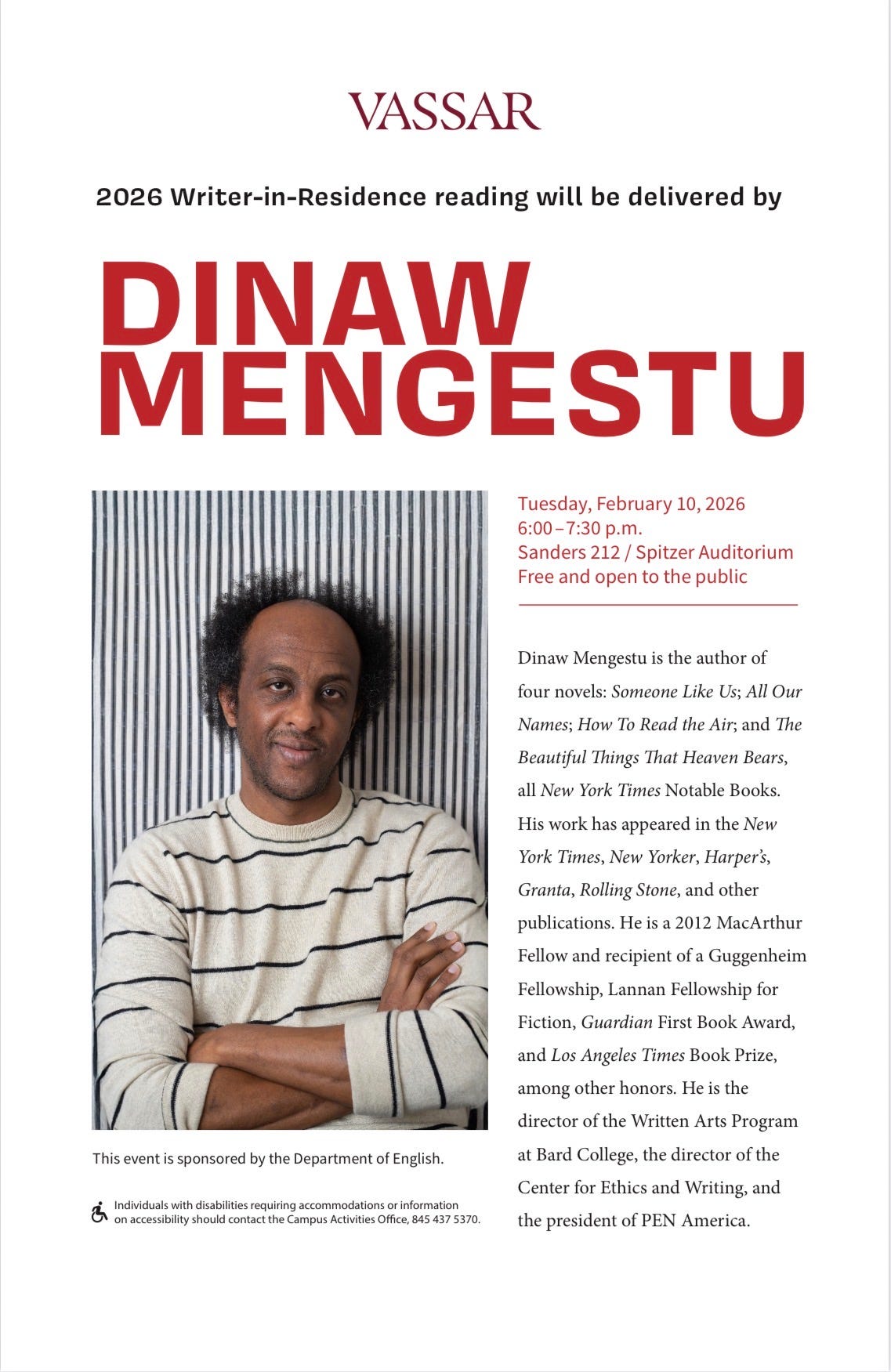
Vassar College’s 2026 writer-in-residence is Dinaw Mengestu, a prize-winning novelist, recipient of the MacArthur “Genius” Award, and the director of the Written Arts Program, as well as the director of the Center for Ethics and Writing, at nearby Bard College. Dinaw delivered his lecture earlier this week and then, two days later, he visited my class. We had just finished reading V.S. Naipaul’s A Bend in the River and Dinaw’s own short-story “The Paper Revolution.”
Dinaw’s debut novel, The Beautiful Things That Heaven Bears, won numerous awards, including the Guardian’s First Book Award. Early on in the novel we find that three young men in Washington D.C., all three of them from different parts of Africa, play a game when they are together: in this game, they recall the different coups and insurrections that have taken place in Africa. One will name a dictator and the others have to guess the year and the country. They tell each other that when there are no more coups in Africa, they will stop playing the game. It is a game rich with many ironies. But when I came across it, I had a different thought. Because of the work that writers like Mengestu have done we could play a different game ourselves. Mengestu is a part of a crop of writers from Africa, Asia, and Latin America who when we invoke their names immediately call up a distinct geography and a history of overlooked lives. This literary game is what I would like to play with the students in my class. I mention a name and you name a title of one of their books and the countries that they claim as their origin. Dinaw Mengestu? … NoViolet Bulawayo? … Junot Diaz? … Valeria Luiselli? … Arundhati Roy? … Kiran Desai? … Adana Shibli? … Teju Cole? … Eva Baltasar?… Mohsin Hamid? … Monica Ojeda? … Hisham Matar? … Noor Naga? …
It is striking to me that so often in Dinaw’s fiction we meet characters who are carrying on a conversation with literary works. They are inspired by literature. The narrator of The Beautiful Things That Heaven Bears receives as a gift a copy of A Bend in the River—this is partly because he, like Naipaul’s narrator, is the owner of a rundown store. He also reads Dante. (Dinaw’s title comes from Dante’s Inferno.) Similarly, the protagonist of All Our Names has traveled to Uganda from his native Ethiopia because he is inspired by the African Writers Conference that has taken place in the decade immediately preceding when this novel is set. Dinaw’s characters, even as they flail and fail, reach out for books to make sense of their lives. I asked Dinaw how important literature was to his characters. He said that there is nothing outside language, no language other than the language we encounter in literature, to describe or even to understand politics and the longings of people. His characters are all in the best sense of the phrase “paper revolutionaries.”
During his visit to my class, Dinaw quoted for my students Fredric Jameson’s insight that the ability to see ourselves reflected in literature imparts to us the sense that we are part of the larger society. He also elaborated on Toni Morrison’s observation about the absence of interiority in the earliest slave narratives. If we consider the example of the slaves who were denied any meaningful access to an autonomous self, we can see that in other literature too the absence of interiority can demonstrate the absence of a narratable self. A further point that I found quite intriguing, perhaps because I hadn’t thought a lot about it in exactly those terms before, was Dinaw’s remark that he worried about making his characters too familiar. This was an ethical impulse on his part. I feel he was saying that his subjects deserved to retain their mystery and even, perhaps, their otherness.
In All Our Names, Dinaw is interested in the time between the optimism of newly-gained independence in a postcolonial society and the rise of an authoritarian state. This is roughly the same canvas on which, many years ago, writing in the very decade when Dinaw’s novel is set, V.S. Naipaul had produced his pessimistic masterpiece set in central Africa. So I asked my students who had read Dinaw’s “The Paper Revolution” (excerpted from All Our Names) to present their thoughts beside what they had gleaned from their reading of A Bend in the River. The students in their responses were alert to the similarities between the two texts. They remarked how power in the form of the President in both stories operates by performing a certain identity and through the use of language in manipulative ways; the idealistic youth, in both instances, assume new, changing identities, in their own anxious pursuit of authenticity. The narrators of both tales are outsiders who, nevertheless, also have inside knowledge; both narrators demonstrate a particular kind of observational acuity (Dinaw agreed, saying that under conditions of oppression “watching becomes a type of action”). In both stories, violence is its own kind of language. One student wrote: “Naipaul and Mengestu share the miraculous ability to make the political deeply and viscerally personal.”
Before leaving my class, Dinaw said that he saw in Naipaul more the representation of the colonized than of the colonizer, in part through the self-loathing that is inside Salim, the protagonist of A Bend in the River. The venom that is expressed towards everyone and everything around Salim sits so deeply inside of him—it strikes the reader as one of the deepest consequences of colonization. The conclusions that Salim reaches are so profoundly flawed and problematic that they have the feel of an honest representation.
Now that you mention him, I am going to read him. Loved your piece in Outlook.
Kumar! Naipaul! Mengestu! Too much brilliance in one room 🕶️