
How To Fail Properly
Also, please subscribe to Brick and to Article 14


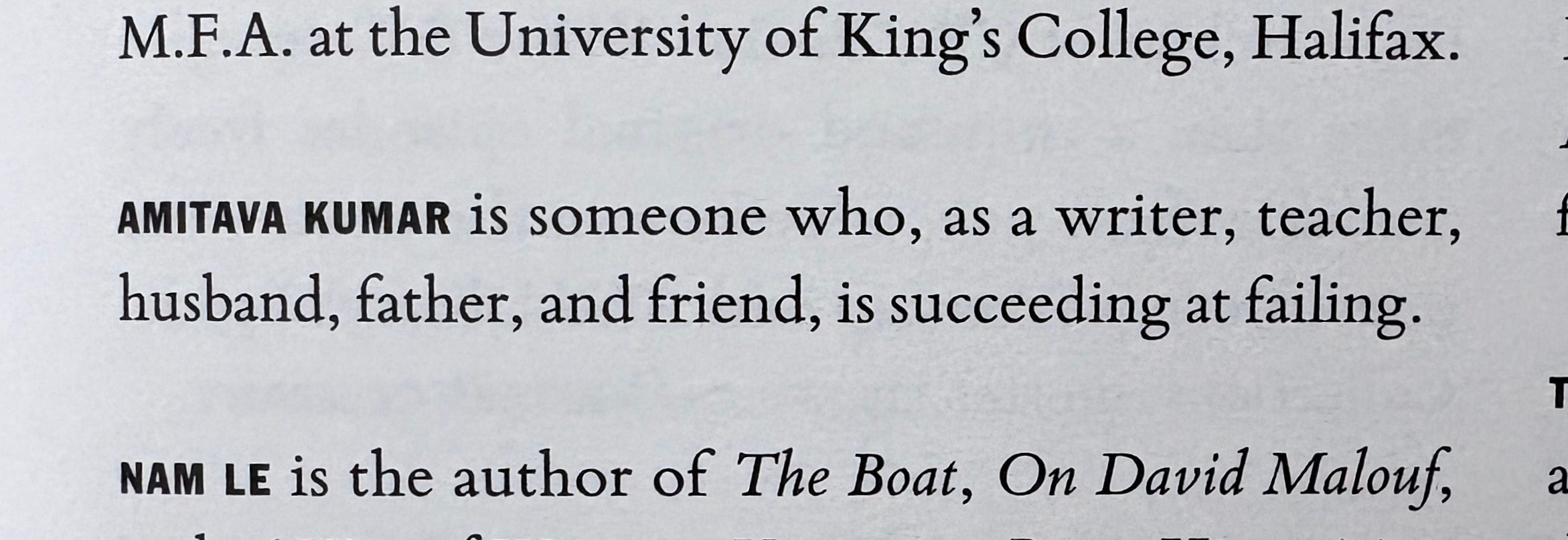
The new issue of Brick is out. Among the offerings are pieces and interviews with some of my favorite people—plus a series where writers have been asked to share their obsessions (50 words). See below. I’m one of the contributing writers and am sharing not only my obsession but also, as a bit of a joke, my bio in this new issue:

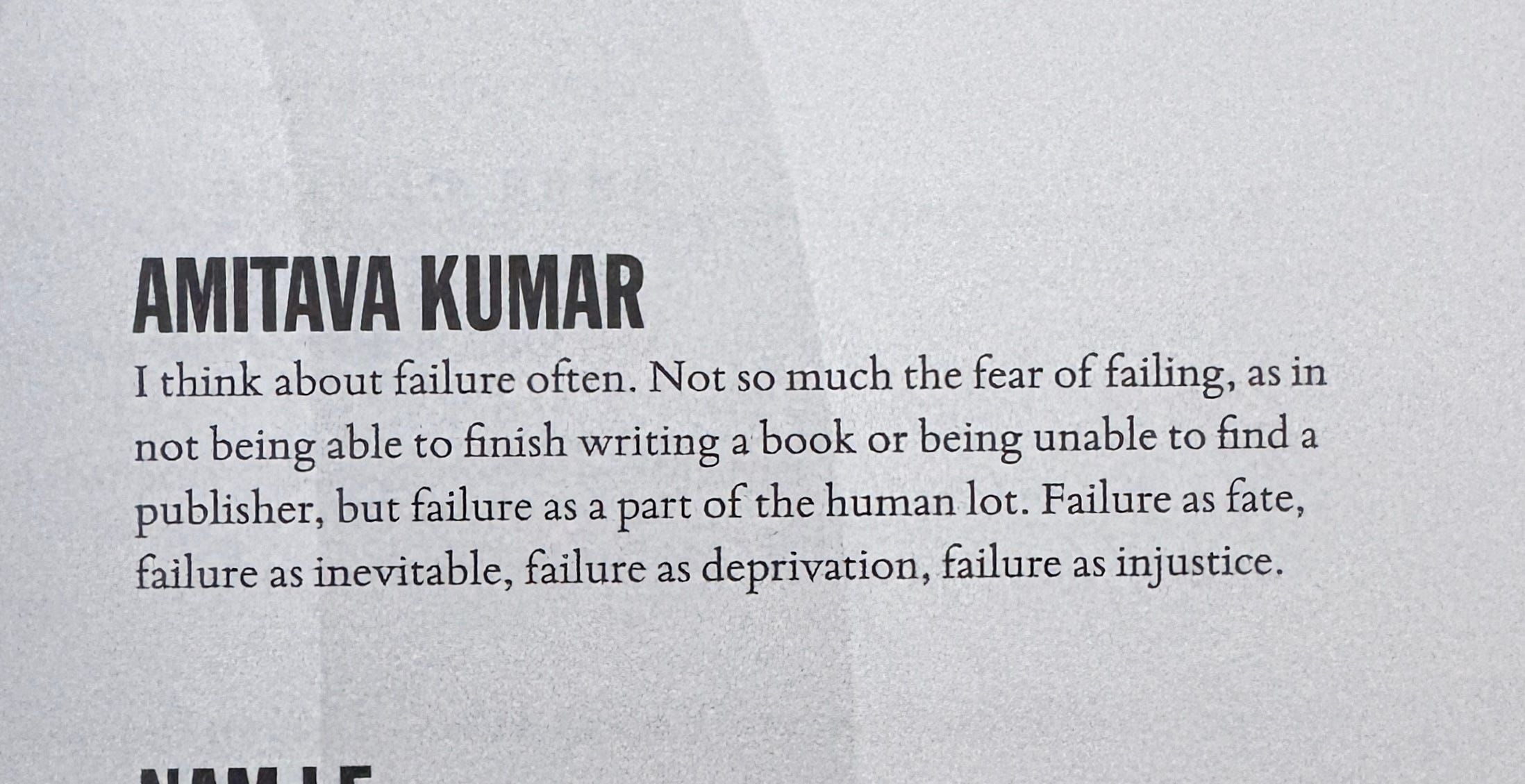
I think it is right for writers to be counted among the defeated. Or at least on the side of the defeated. How can you want to be anything else if the people who are talking of winning happen to be Trump and his ilk. (I remember Trump’s saying back in 2015 that John McCain wasn’t a war hero because he was captured and taken prisoner. Trump had gone on to say that McCain was a loser and that he didn’t like losers.) I’m obsessed with failure because I’m aware that Adani’s mines in India are turning forests into wasteland and driving the indigenous inhabitants into nomads; that over 500,000 men and women in India are in prisons, with over 70 percent of them simply awaiting trial (in my home-state of Bihar, the percentage of undertrials in 87 percent); talking of prisoners, I think of Sanjiv Bhatt, the whistleblower policeman in Gujarat, who was removed from service and thrown into prison. I often think of jailed writers and activists when I, a free man, am about to go to sleep in my own bed. Celebrations of success seem shallow when we are faced with such systemic failures in our society.
Under such conditions, the only way to be is to fail properly: it means to go on struggling despite overwhelming odds. As I have mentioned prisons above, let me note the work of those who have made it their mission to help those who are illiterate or otherwise unable to find their way out of prisons in India. We have to congratulate Umar Khalid who despite being in prison without trial for years will soon have his book based on his Ph.D work published on June 26. Three years ago, the director of the International Institute of Population Studies in Mumbai was kicked out of his job after the institution he headed released data that contradicted the official narrative: the Prime Minister had declared that India was “open-defecation free” but the data on the ground showed that in Bihar, for instance, only a little more than 50 percent of the rural population had access to toilets. To point out these failures instead of waving the false flag of success is a good way to fail.
We can let fatuous men going on about India’s 5000-year-old civilizational legacy choke on their own vomit (I really only mean Suhel Seth); instead of their tawdry optimism, what we need is clarity and truth. For us to be able to see that there are large numbers of poor workers kept in near-captivity in Gujarat, according to a recent report for Article 14, as bonded laborers. Mainstream news doesn’t provide such news; please don’t fail to subscribe to news sources like Article 14.
Thank you. It is reassuring to know that there are others who feel just as helpless- it is like the solidarity of the helpless. Watching the documentary on Ravish Kumar brought it home most poignantly.
Well said Amitava. You say it right. Wake up every morning to outrage across the world and then finding one really is helpless. Writers, journalists et al