
Homebound Oscarbound
In Which I Recommend A Film

Thanks to Jahnavi Sen at The Wire, where this note was published today:
We will find out very soon whether the film Homebound, India’s official entry for the 2026 Academy Awards, will be among the finalists. I was watching Homebound today because I have a more urgent need: a new semester of teaching is about to start and I want my journalism students to figure out how a piece of reportage, both masterful and empathetic, was turned into a powerfully affecting film.
In the summer of 2021, with the coronavirus pandemic having abated but still not over, the Kashmiri journalist Basharat Peer published a piece in the New York Times describing a fateful journey undertaken by two youths from Surat to their village in Uttar Pradesh. This difficult trip was undertaken during the brutal lockdown imposed over all of India with the intention of stopping the spread of the virus. A nation had been pushed to the brink of desperation: without work, and with no pay, the poor in particular were starving. For daily-wage workers like the two youth in Peer’s story, Amrit Kumar and Mohammad Saiyub, it was worth risking the state’s wrath and finding a way home.
What I would like my students to note about Peer’s report is that every bit of story that he offers about the two friends making their arduous way back and then one of them falling sick and the other refusing to leave him alone, every detail in this story is repeatedly framed by statements about the Indian polity and contemporary changes. It is a deft act. A particular kind of contrapuntal manoeuvre bringing together what the radio-host Ira Glass calls anecdote and summary.
Peer’s dialectic dance is a beautiful piece of journalism, but it is not something that can be done in the same way in film. What makes Neeraj Ghaywan’s Homebound a moving piece of work is that it finds context by going out of the story printed in the New York Times and giving the two protagonists a rich life before Covid. When I had first read Peer’s report, and liked it immediately, I had felt this was a story that the world needed to know. A remarkable feature of Homebound is that it broadens the canvas and offers a larger story that, as much as the rest of the world, Indians also need to watch and learn about themselves. There is a lot, under the current dispensation, that we Indians don’t want to know and, often enough, aren’t even allowed to know.
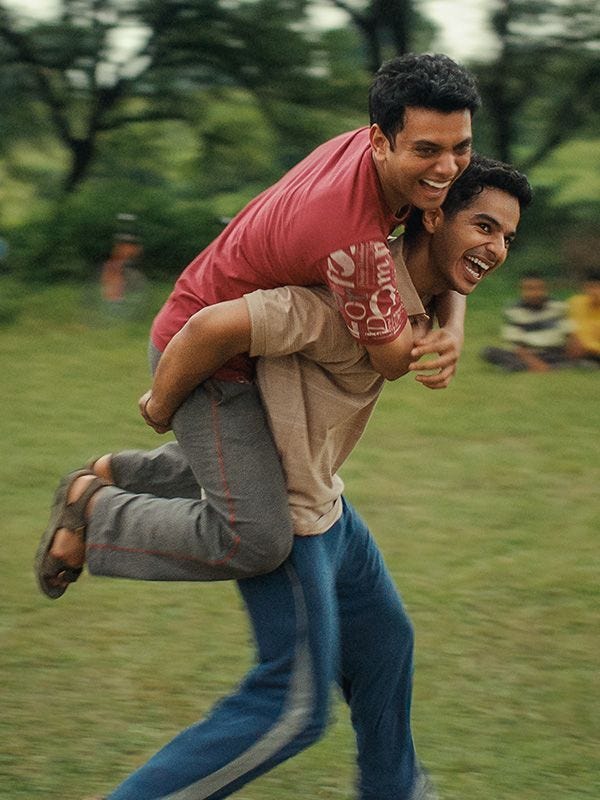
When Homebound opens we meet the two friends – their fictional avatars are named Chandan and Shoaib – as they arrive at a train station. They are going to take the police constable recruitment test. The entire train station is flooded with young candidates just like them. The scene appears familiar because we have witnessed it ourselves. In one of my writing notebooks, I have a news clipping from 2020 showing men clustered at each door and window of a train in my home-state Bihar: the would-be passengers were among the 1,700,000 applicants who had appeared in an exam for 1,100 positions open for constables in Bihar police.
We get a clue here about what will force Chandan and Shoaib to end up in a factory in Surat. It’s not just the pressure of the population, of course. Chandan is a Dalit and has to contend with the existential crisis caused by caste discrimination – in a later scene in the film we watch his mother, an anganwadi worker at a village school, being cast out of her job because the upper-caste families don’t want their children to eat food cooked by someone they regard as untouchable, all the laws and the Constitution be damned.
Similarly, Shoaib is Muslim and faces bigotry at the first job where he joins. I don’t know what an Academy member in, say, Los Angeles will make of a scene where Shoaib’s superior at the job, apparently a Brahmin, asks his name and then instructs him not to bring him his water. But that scene and the others that follow ought to be watched with attention by Indians because they present accurately the humiliation routinely meted out to minorities.
I asked Ghaywan, the film’s director, to tell me more about films that had been inspired by news reports. He gave me a long list of famous films of world cinema but singled out Sidney Lumet’s Dog Day Afternoon (1975) that was based on a story in Life Magazine about a bank hold-up. Ghaywan had found out about this origin story only recently; he had been struck by the parallel narrative about two friends courting danger for a cause. When I asked Peer the same question, he said he had loved the film adaptation of John Steinbeck’s novel The Grapes of Wrath. When Peer said this, I remembered that he had invoked Steinbeck’s novel in his original piece. He had compared the huge masses of poor workers migrating during the lockdown to not just the Partition refugees but also the Oklahoma farmers migrating in large numbers from the Dust Bowl to California (“except the Indian workers were fleeing their Californias for their impoverished villages”).
There is a scene in Homebound where one of the migrant workers in Surat named Ghanshyam says: “Corona se baad mein, bhooke mar jaayenge pehle (Hunger will get us before Covid does).” This was another piece of dialogue where I recognised the words drawn from real life. This is what it is necessary in journalism: keeping alive the words of those whose voices have been left unheard. As Varun Grover, one of the writers involved in the film, told me, Chandan and Shoaib represent those countless people who were harassed and humiliated during Covid. “These are characters whose lives have been banished from Hindi films because such lives have been pushed out of our consciousness,” Grover said. In one sense, Chandan and Shoaib can be seen as minorities, he said, but in actuality they constitute the majority of India, the vast teeming population that we are trained not to see.
(A note for journalism students everywhere: The character of the migrant worker Ghanshyam mentioned above is played by the poet and performer Aamir Aziz. How did you prepare for that role, I asked Aziz. He said, “I had met many workers during the lockdown, several of them became my friends; for me to play this character was a bit like remembering those worker friends and showing my love for them.” Yes, go out into the world, find people, make friends.)
What Homebound is really successful in doing is using its poetic eye and a lyrical language to give its subjects a beautiful dignity. Chandan and Shoaib are not mere victims. We fall in love with the characters because they offer us so much of their lives. I don’t think I will ever forget the words with which Shoaib explains why he cannot leave his home and migrate to Dubai; nor can I ever escape the anguish touched upon by Chandan when he describes what happens when he tells people his real name and then what he undergoes if he hides it.
What touched you the most in the film, I asked Peer. After all, it was his work that started the process. He had watched part of the film with his father who was very sick, and then he had taken his laptop up to his room to watch the rest. The scene where the truck driver asks the two to get off the vehicle, leaving them alone on the empty highway. Chandan was coughing and the other travellers had suspected that he was carrying the virus. Peer reminded me that Shoaib doesn’t abandon Chandan. That is the heart of the story. He said, “In this callous world full of talk, posturing, and performative solidarities that quiet, simple act of not turning your back on a friend is the greatest act of love and friendship.”
My students are returning to campus from their homes. It is very cold here. Some of them are coming from towns that have seen protests against the actions of I.C.E., the stormtroopers of an authoritarian and racist regime in power in Washington. What the protests have revealed is the power of caring and community. This is the most important news-story at this time. Love thy neighbour, the way Chandan and Shoaib loved each other.

Dil aur dimaag dono ko chhoo liya!! Thanks for this wonderful post!!
I have seen the film but reading these “notes” for your lucky students was like seeing it on a big, big screen with every pore visible. Thank you, Amitava… you always open our eyes to unfiltered beauty.