
Going Home Like
Except, except....

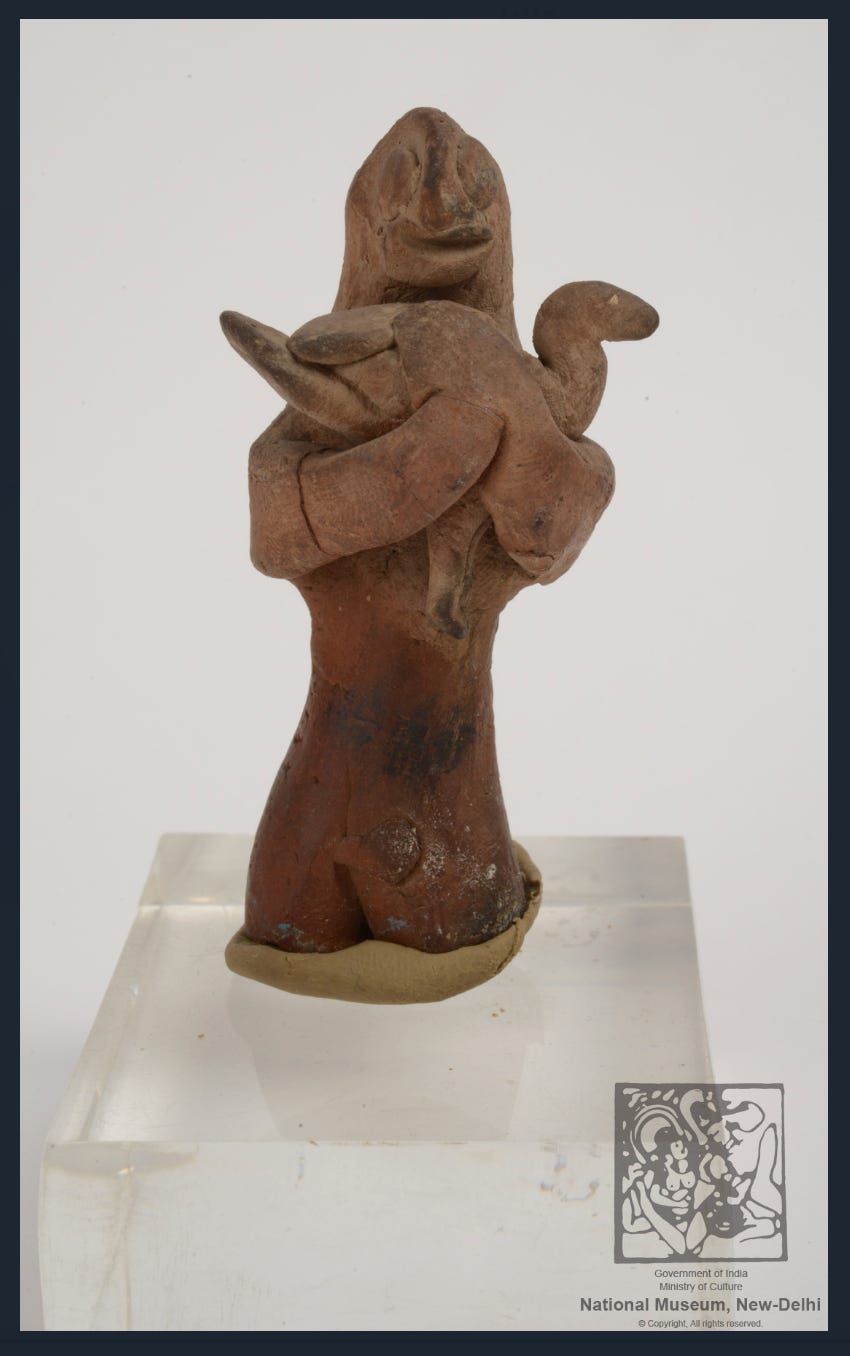
Male Holding a Duck National Museum, New Delhi
My new semester at Vassar is about to start; I’m soon going back from India after spending more than a month here, chasing stories. Last week, when I was in Delhi, my friend Niruapama Kotru told me that I just couldn’t shove off to my hotel room to take a nap. Instead, I ought to go to the National Museum. She proceeded to call her driver and took me there herself. Nirupama was especially interested in my seeing the famous figurine from the Indus Valley artifacts called The Dancing Girl (circa 2500 B.C.). When we were standing face to face with the small, impressive statue, I remembered the poem by Agha Shahid Ali. Also a more recent controversy, the stinging critque of the “Fair & Lovely” Dancing Girl, written by Shuddhabrata Sengupta, a critique of the Babu imagination of the patriarchs in power.
The curator who was showing us around made a remark in the pre-history section that I quickly noted down in my diary. Pointing at the small figures and toys and shapes of utensils, she said that while the Egyptians relics from pre-history are huge, monumental structures, here among the Harappan artifacts you are in a more democratic space of representation. The figurines we were seeing were often of women and children in domestic spaces. What pierced me was the curator’s singling out the figure you can see above—and her saying to me, with softness in her voice, “an early example of biophilia.” The piece is only 7 cm. by 2.5 cm and the museum description says “A terracotta male figure holding a duck in his arms. His legs are lost.” Am I being poetic when I think the creature being held could well be a swan? Whatever bird it might be, I love the tender embrace!
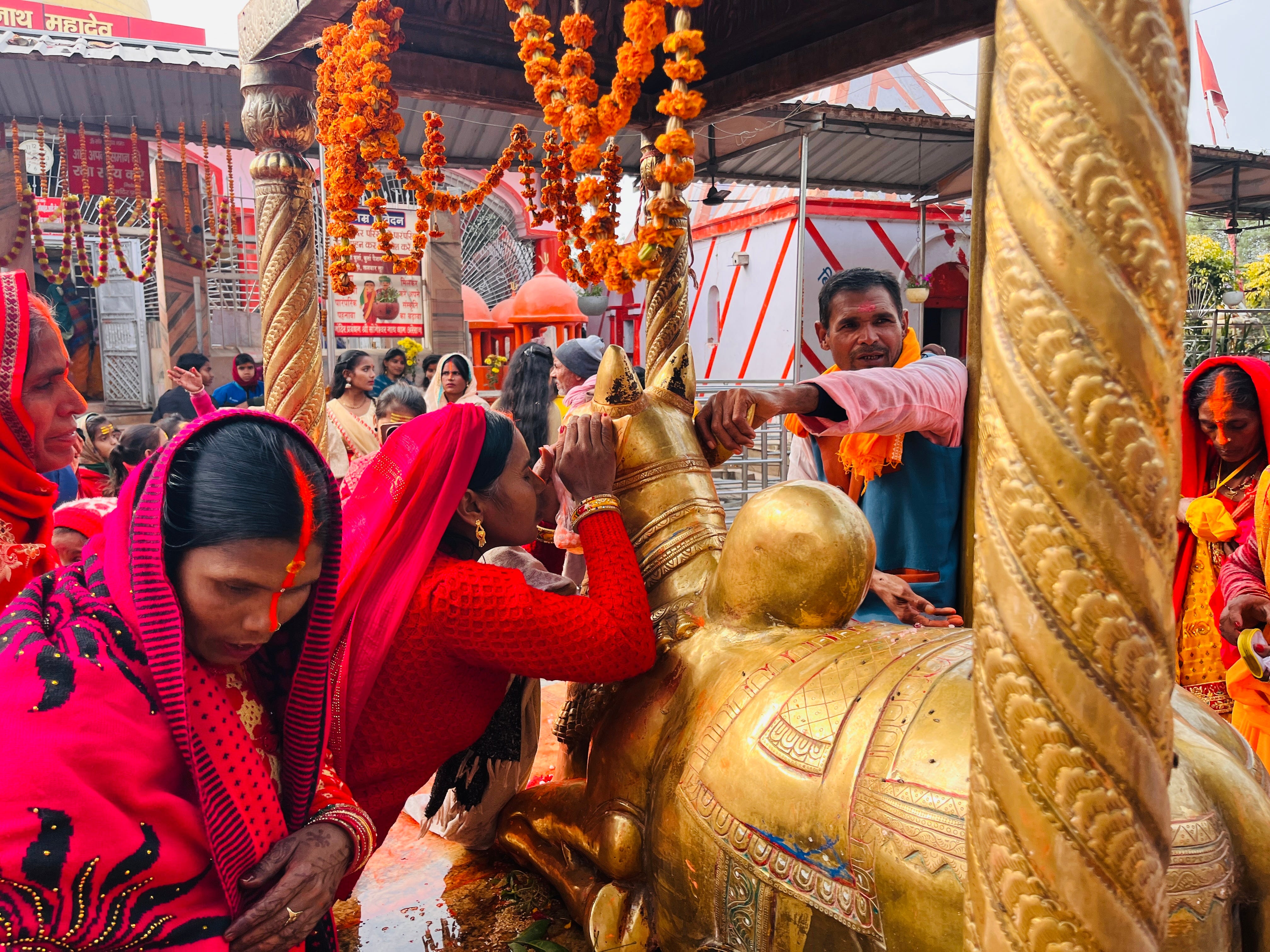
A parenthetical aside. I witnessed another such embrace a few days later: a woman was whispering into the ear of the Nandi bull sculpture while holding the scared bull’s ear. This was when I went from Patna to the temple town of Arreraj in Champaran. Arreraj is a short distance from my ancestral village and my sisters and I were often taken there to worship at the temple of Lord Shiva.
Back to the National Museum. It is slated for demolition. Why? The reasons remain a bit unclear. A distinguished historian has asked “what is the announced reason behind the demolition of the 1960 building of the National Museum and the placing at immense risk of all the irreplaceable archaeological and art historical artifacts that it houses? It is a public institution, always intended to be one, and every government stands obliged to hold these objects in safe and professional custody for the nation and for posterity.” It appears there is a plan by the current regime to build a new building called the Yuge Yugeen Bharat Indian Museum. How will entire walls of old, priceless art (I mean literal walls, paintings done on walls) be moved without damage? What is this reckless vision (is vision even the word I want?) that will thus endanger the past?
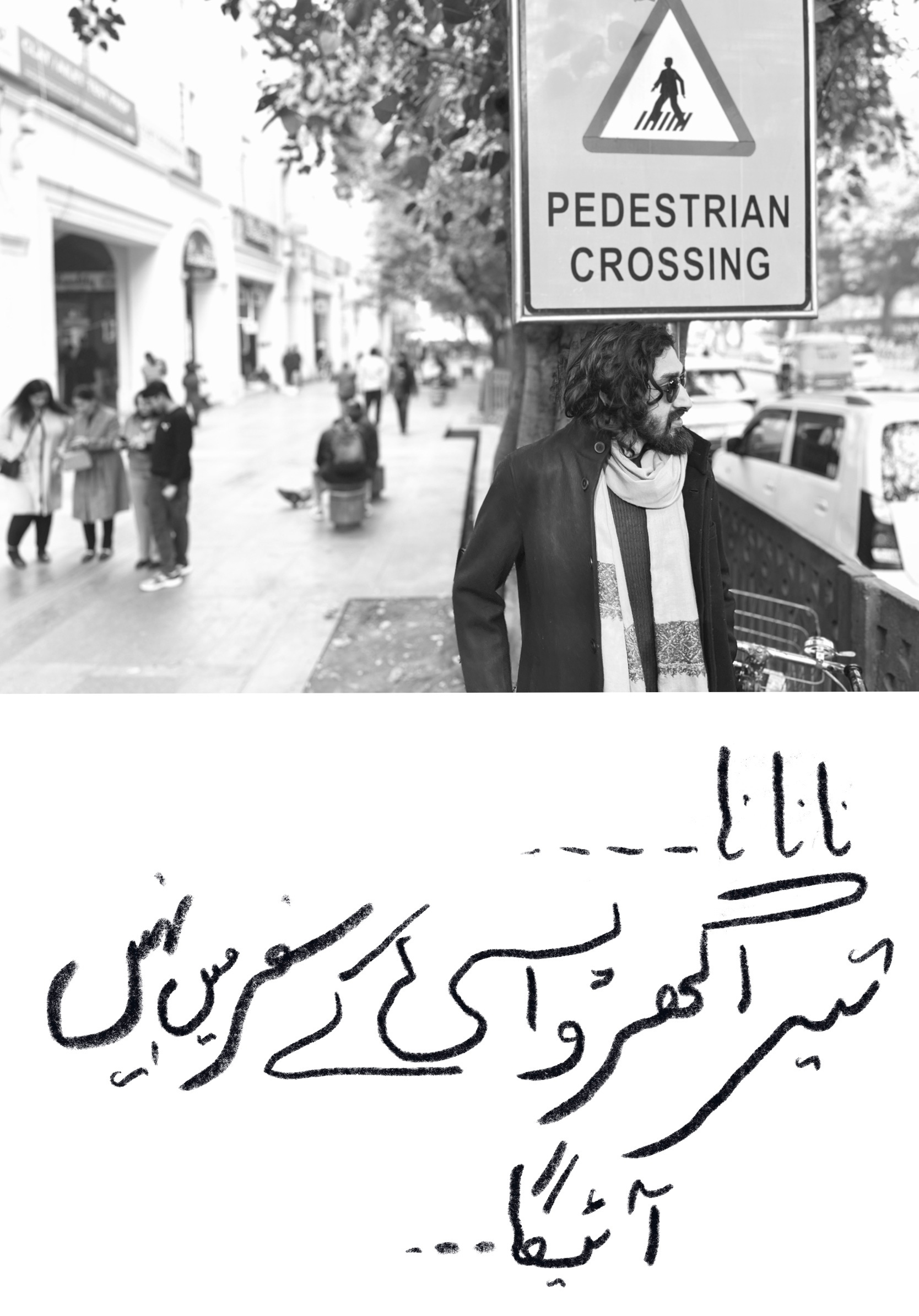
I have been trying to map in my own way the path that development takes in our country. See my recent report in BRICK magazine of my journey along the Ganges. I need more time to do such work; I’m grateful to my wife and kids for having put up with my absence for these past weeks. Did I come home when I came back to Patna? Am I returning home when I return to the U.S.? Who the hells knows! (Do you remember my mentioning in a few recent posts my reading a book for my journalism class for this coming semester? In its pages an editor says, “Sometimes I ask a writer to describe the story in six words. Then I ask if she can describe it in three words. What about one word? That focusing exercise moves the writer from content to meaning.” What would my six words be? One of them would have to be “home” right after “loss.”) In this interview conducted in Hindi, I had said that as a writer I was a citizen only of the land called language. A good answer, sure, but minus all the emotion. I don’t want to sacrifice my emotional truth even as I seek the right words in that mysterious nation called language. A better answer to the question of returns was provided to me by poet and professor Usama Zakir who wrote in my diary: Na, na, na… / tera ghar wapasi ke safar / mein nahin aayega. (No chance, not at all. / No return journey / can ever take you back home.)
Thank you for the link to your piece in Brick magazine. I look forward to reading it. I too am perplexed (yet, sort of not perplexed, because I imagine the pumped-up chest visions of new monumentality that informs it and other architectural and urban planning monstrositieswe've seen in recent years) by the seemingly rash project to tear that museum down.
There is nothing that tells almost all as the loved pain and unattainable yearning to go home. You have followed the footsteps and curiously given me if not home a touch of going home to a India I will never see nor touch. Yur walking down a Patna path to see friendst the statue man holding the bird, the pond that was a dirty puddle, the men greeting you on arrival and the woman whispering wishes in the ear of the golden bull hover now near the ache of going home.