
Emma Thompson is Indignant
A.I. and its offers to help you write

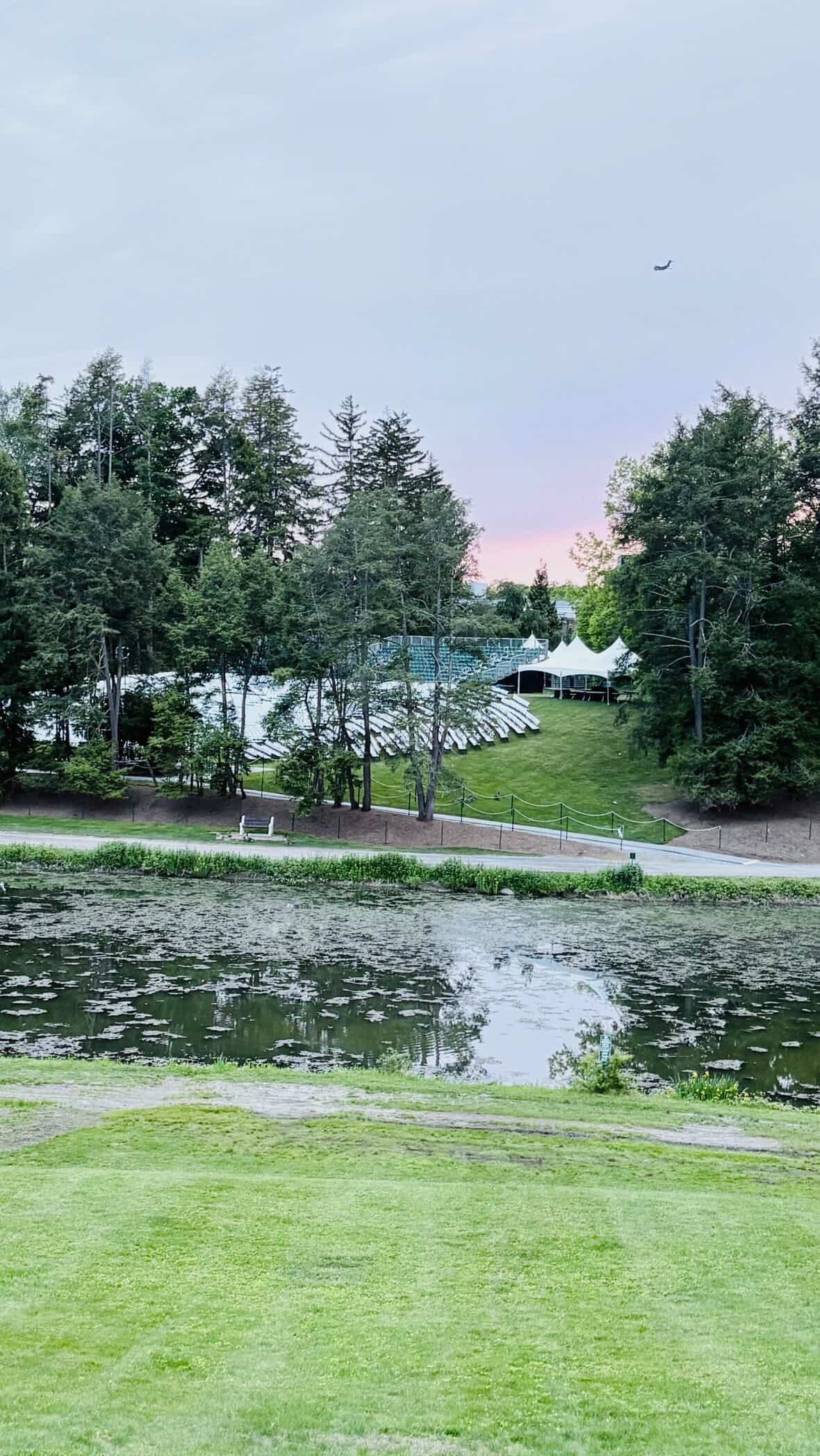
An evening in May. Classes were over and it was either just before graduation or the day after. I was taking a walk on my college campus and stopped for a minute to take a picture for my friend Jordan. I send her occasional pics unimaginatively but accurately titled “Live from Sunset Lake.” When she was a young undergraduate here a few decades ago, she read important works of literature sitting on this hill. As it happened, undergrads were on my mind during that walk. I was asking myself how I could design an assignment on the opening day of class for my essay-writing class for first-year students. To aid my thinking I was listening to an A.I.-generated voice reading out my former colleague (and still-current, thank god, friend and occasional hang) Hua Hsu’s excellent article from last year on A.I. and the end of the college essay. I wondered if I could start the semester by asking students to read Hua’s essay and then conduct two exercises in class: first, using pen and paper, the students will write their own take on Hua’s piece, taking maybe 15-20 minutes to write and revise a paragraph-long report; next, they will be asked to write, again only using pen and paper, in 15-20 minutes, how they think ChatGPT would present its own take on the same essay. Then we will discuss the differences, if any, between the two versions.
You know where I’m going with this. You have probably watched Emma Thompson describing her response to A.I. As a teacher, I know that ChatGPT, as Hua’s piece clearly shows, is a part of the lives of my students. My aim in the classroom and maybe in my own life is to better grapple, instead, with what is involved in any process of creation.

One particular exercise that is useful in my class is our attempt to produce “bad writing.” (Here is one post I made on the subject, and here is another post in a different setting. You might also want to read this post where I report on Ayad Akhtar’s play “McNeal” about a writer who uses A.I. The play was performed at Lincoln Center with Robert Downey Jr. as the lead.) It is possible that what I’m planning to do with Hua’s essay will be a part of that same exercise but my goals are more specific. This became clearer to me when another friend, the photographer Accra Shepp, urged me to read a recent piece by Dan Chiasson in the New York Review of Books. (Accra acknowledged that he was distracting me, and he was, but diversion is part of what the essay regards as thinking and doing. An important feature of intelligent writing is to track the changes that take place in our thinking as a result of these distractions. Process.) Titled “Think for Yourself,” Chiasson’s essay is a meditation on writing in the age of A.I. One of its interesting qualities is that in an attempt to counter the unnaturally finished character of A.I. writing, Chiasson’s piece offers an account of its own evolution. I liked the essay for that reason, how through its very form it slows down time and presents a rich, densely proliferating account of the connections that arise in the author’s imagination. There are many other things to admire in the essay, not least its demonstration of the fact that when you go out on walks, with or without a canine companion, it is usually good for your thinking. (I often put in my pocket an index card and a small pencil.)
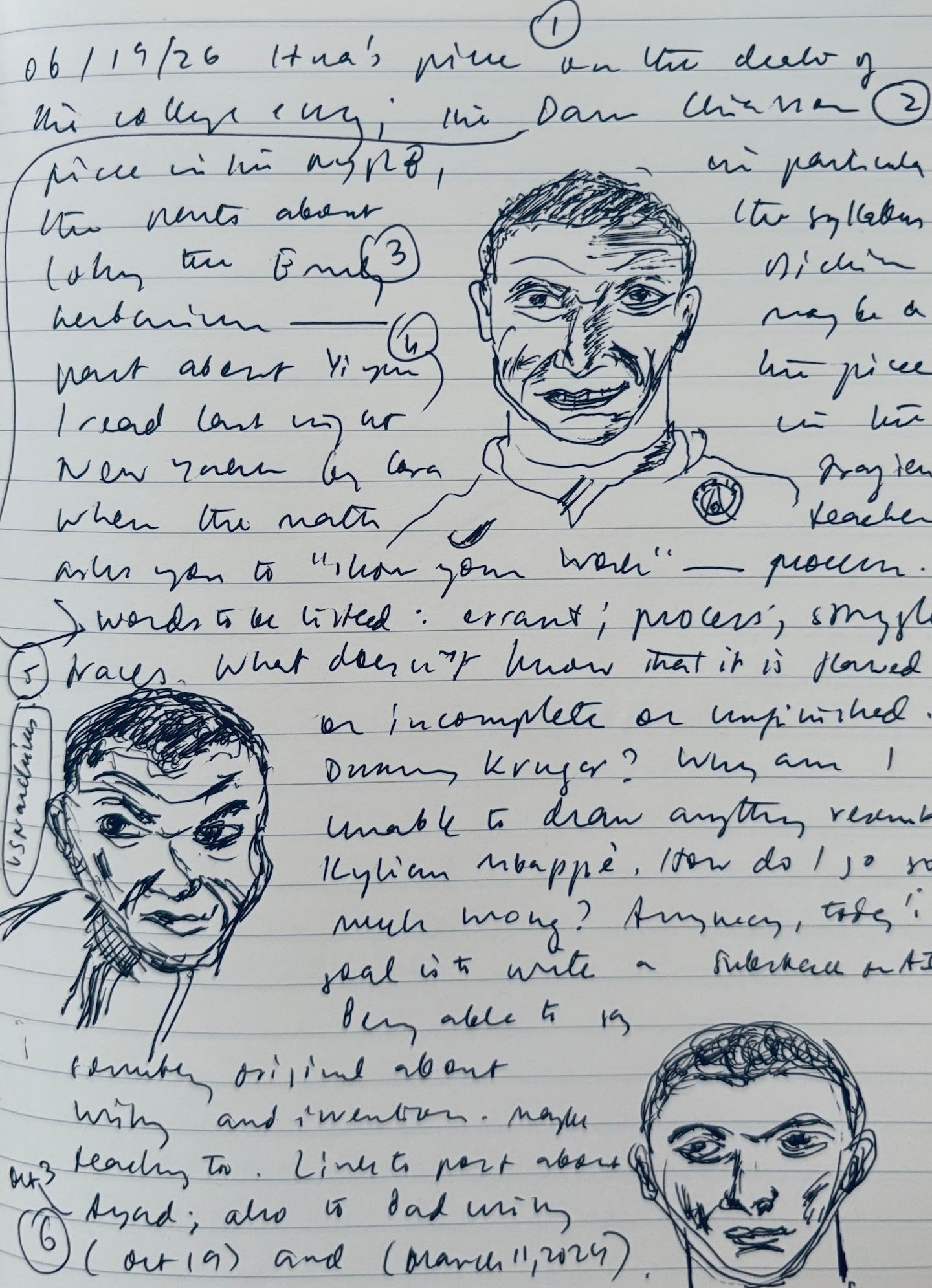
One terrific line in Hua’s essay is this one: “A.I. allows any of us to feel like an expert, but it is risk, doubt, and failure that make us human.” That is it. That is the lesson I wish to impart to my students. Above, following Chiasson’s example, I noted down some words I wanted to play with: process, errant, struggle, traces. Also, re: failure. Please note my dismal attempts to sketch a face of a footballer I like. It is okay, it is all good, I’m telling myself. Don’t ask A.I. to make you a drawing, keep doing it yourself, keep failing, you are learning. What I also liked in the Chiasson piece and which I will probably incorporate in my syllabi is the way in which he ends his statement on A.I.:
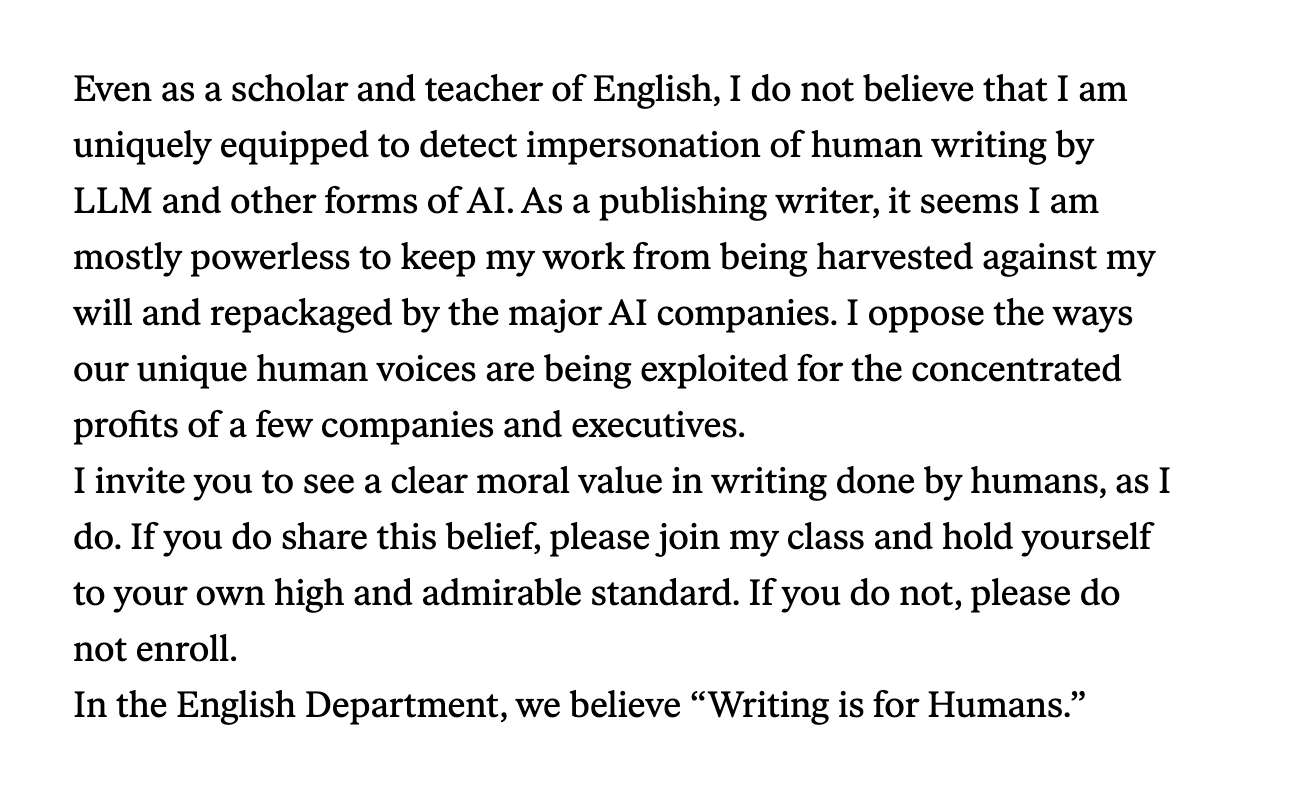
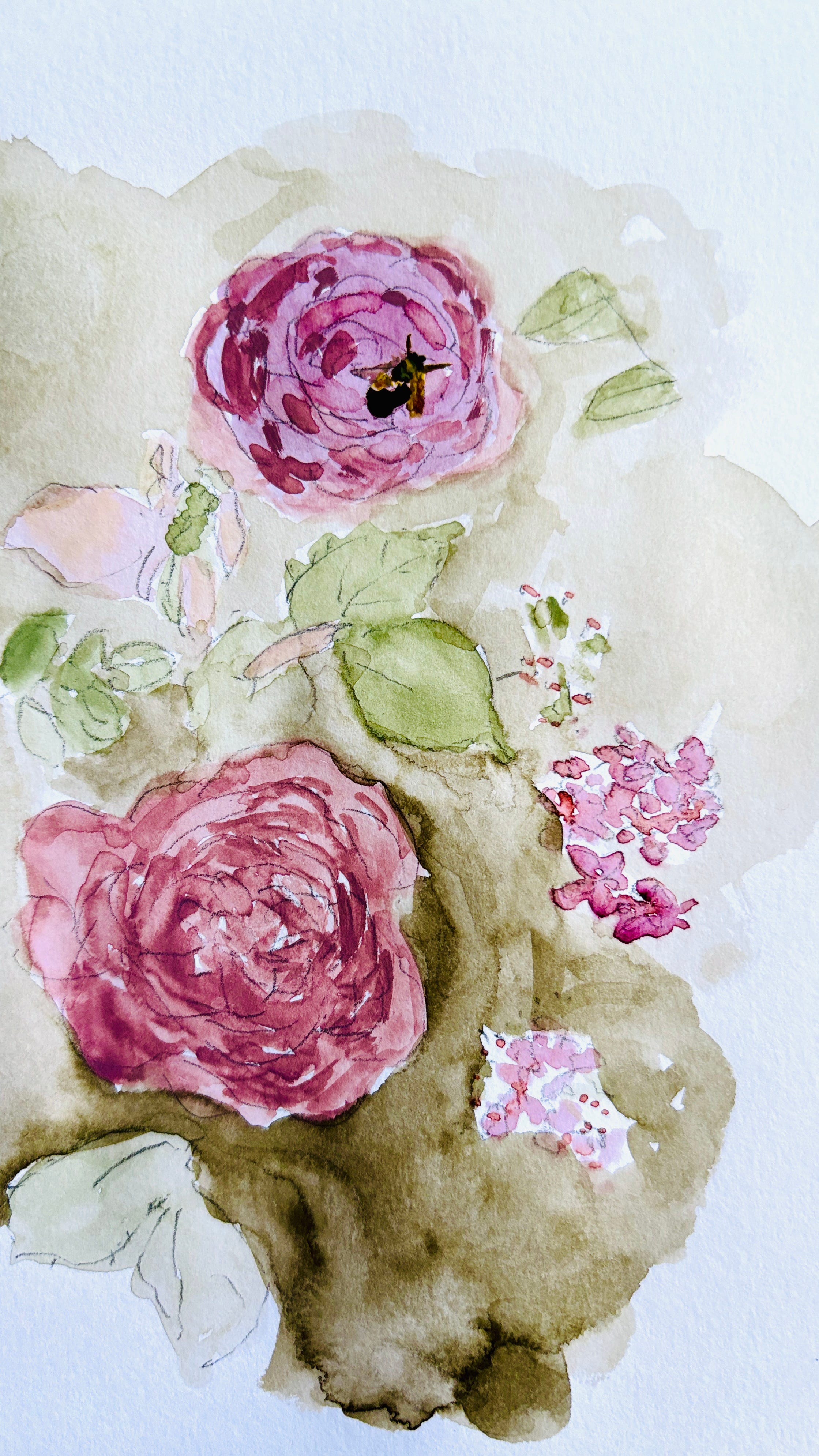
The reason why Accra sent me the above piece was that it was accompanied by a photograph of Emily Dickinson’s herbarium preserved at the Houghton Library at Harvard. Accra would see me during our days together at the Cullman Center making drawings. (I was—I am—interested in what other writers were drawing. These days I take note of the photographs that the wonderful Yiyun Li posts of her garden and then I try to paint Yiyun’s flowers. I’m always aware that I get something right and many things wrong.) Drawing is a way of being in the world: it is and it isn’t a distraction. For me, the engagement with the visual, even if it only means putting in a unexpected post-card in an essay, is always a way of disrupting the narrow or flat linearity of more predictable writing. Like writing in longhand, the idea of engaging other senses just makes me feel more alive, as if more of me were present in the act of writing. None of that is going to happen if I feed in a prompt and get something from ChatGPT in a matter of seconds.
P.S. I was reading a recent issue of the New Yorker magazine in bed last night. There was this funny Cora Frazier piece about L.L.M.s.
Hello Ami aka Prof. Kumar, This is some off topic, but thinking of your post of the sumptuous watercolor roses and bee . Often these lines Emily D. are in my dream mind and now float back.
To Make a prairie it takes
a clover and one bee
one clove and a bee
and revery
The rverie alone will do
if the bees are few.
Thank you for theses hours of peace and yes, revery your Substack brought and brings.
Mary McGuire
I don't touch the stuff!