
Beneath the Surface
A longing for peace during a time of war

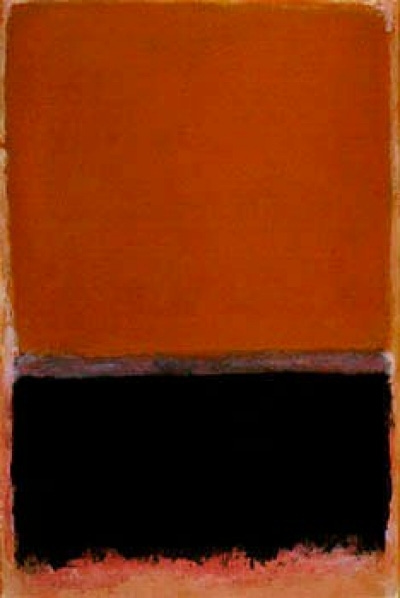
Mark Rothko, Untitled (1953)
Last Friday I was doing an interview and the interviewer offered me this quote from Mark Rothko: “I would like to say to those who think of my pictures as serene… that I have imprisoned the most utter violence in every inch of their surface.” I think that is the most marvelous quote, both mysterious and provocative.
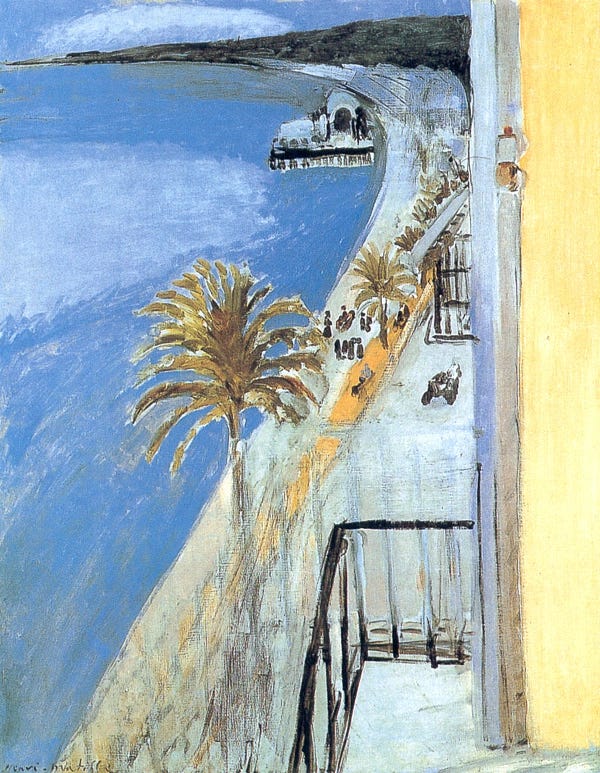
Henri Matisse, The Bay of Nice (1918)
Rothko’s quote makes me think about, say, a painting like the one above. Matisse painted the view from his hotel room in Nice (he had gone there in the hopes of getting cured of the bronchitis that was afflicting him) when the First World War hadn’t yet ended. It is a beautiful picture. Could Matisse too make the claim that he had captured the monster of war and hidden it under the surface? I’m no art historian but surely it makes greater sense to see in such works an artist seeking joy among the horrors of war.
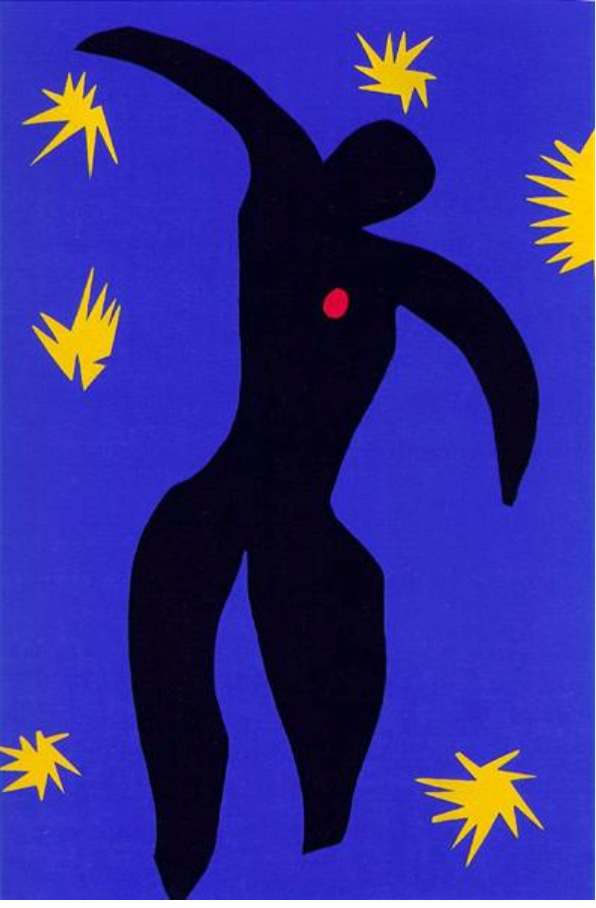
Henri Matisse, Icarus (1943-44)
By the time the Second World War was being fought, Matisse was sick and several members of his family who had been active in the Resistance had been tortured and killed. In 1943, Matisse started making art with cardboard cut-outs and using colors that he described as “vivid and violent.” It is certainly possible to read in the work above the story of a fall and even death by gunshot but, again, difficult not to find the artist, despite his growing disability, seeking beauty and joy.

How to make art, how to notice the flowers blooming in your neighborhood (and how not to notice the flowers blooming in your neighborhood, explosions of pink and white on invisible branches) when you read that 17,000 children have been orphaned in Gaza? That while we have either celebrated or denounced protests on our campuses, babies are dying from hunger? In the absence of food, children dying from having been fed grass or animal feed. Yesterday, I watched a BBC Channel 4 report from Gaza. My heart was gladdened when I saw the smiling face of a little girl and then I learned that she too had suffered an amputation. As had her brother. Both the kids in the video have lost not only their limbs but also their parents and other siblings in this war. After watching the video, although there was urgent work to be done, I went for a walk in Central Park. I made a painting too but I cannot claim that I have imprisoned violence in every inch of its surface. Is it because I have slipped into the illusion that the violence is elsewhere? No, no, impossible, I want to say. And then I consider this. If I could take a picture, a serene still-life, of a breakfast table (dark rich tones of the wood, the white napkin, the china with a blue and gold trim maybe), or a gentle expanse of a blue lake (small white waves adding texture) with the lake’s beauty framed by the large window, or the reflection of flowers on the black-tinted window of a large luxury SUV or the gleam on the chrome of a private jet, these quiet scenes from the daily life of an arms-dealer or a banker or a politician (although there are so many of them, never only an individual, and if it’s a system or a structure, doesn’t it mean all of us are also complicit) benefiting from this human carnage, would I have finally done what Rothko desired?
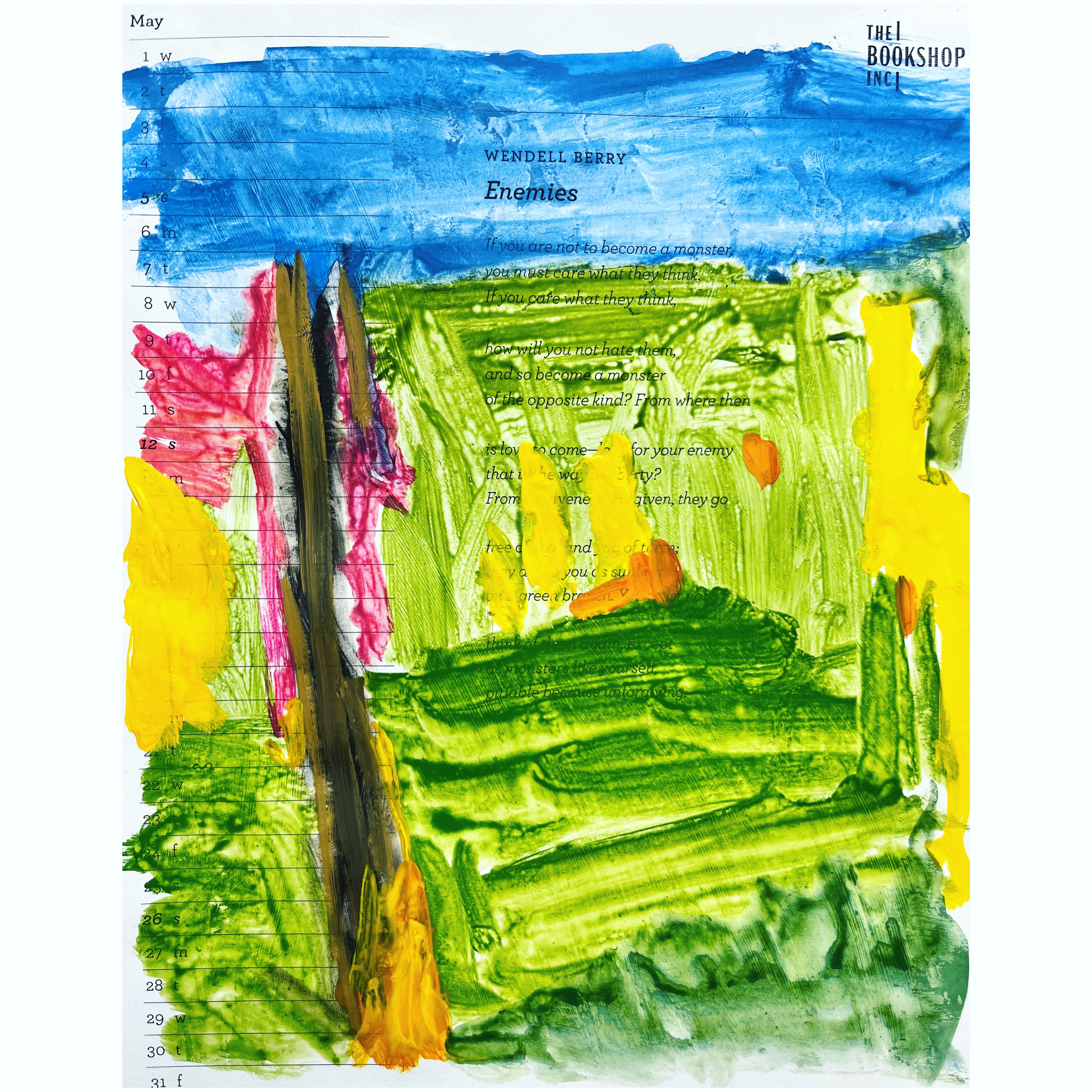
P.S. This painting was done on the May month-page of the calendar given to me by The Bookshop in Delhi. The poem printed on it is “Enemies” by Wendell Berry. The poem begins:
If you are not to become a monster,
you must care what they think.
If you care what they think,
how will you not hate them,
and so become a monster
of the opposite kind?…
Thank you--for the words and paintings.
When I see Rothko's paintings I know that they are sacred. That is not totally correct-- they are holy.
Even now when I remember seeing Rothko's paintings I weep.
Years ago at MOMA I saw a retrospective of Matisse paintings. When you stepped from the room with his early Paris paintings to his Nice paintings you saw his magic. In Nice his paintings shout joy.
I think of the poem by Seamus Heaney " Postscript" and know exuberance. I read the poem on forgiveness that you included and know pain.--my own pain too.
Destruction and joy--how to live with this at hand? You, Professor Kumar, have answers in your page painting and the sunlight on the green branch. I seesaw.
These are the issues that have been preoccupying me. We finally have some spring weather in Montreal, and I'm heading out on the metro to a park to do some sketching. I've been unable to draw or paint for many weeks because of Gaza, and yet I feel that every conscious creative act is a defiant insistence on life, and a memorial in honor of those who can no longer sing, draw, speak.